
.svg)
Connected to everything your business runs on.
IQ LAB connects to your energy retailers, meters, assets and building systems through secure, authenticated APIs - so your data flows into the platform automatically, not manually. Every connection is consent-based. All data is processed and stored in Australia.





Direct retailer connections. Regulated, consent-based and secure.
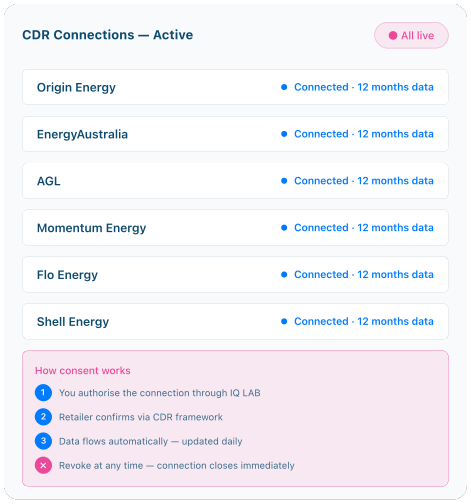
The Consumer Data Right is an Australian government framework that gives businesses the legal right to share their energy data with accredited platforms of their choosing. IQ LAB is a registered CDR representative through Adatree - meaning every retailer connection is governed by the same regulatory framework that governs open banking. Not a platform policy. A legal standard.
When you connect your retailer via CDR, IQ LAB pulls up to 12 monthsof billing and interval data directly. That data is the foundation of accurate bill validation, load profiling for procurement tenders, tariff analysis against actual usage and Scope 2 reporting from real consumption - not estimates.
No screen scraping. No manual exports. No third parties handling your credentials. You authorise the connection, you can see what's shared and you can revoke access with one click.
- Up to 12 months billing and interval data
- 5-minute usage and demand profiles
- Consent-based - you authorise and revoke
- Governed by Australian CDR regulatory framework
- Registered via Adatree - formally accredited
- No screen scraping, no manual exports
- Data stays in Australia throughout
Retailer panel growing continuously. More retailers added as CDR adoption expands.
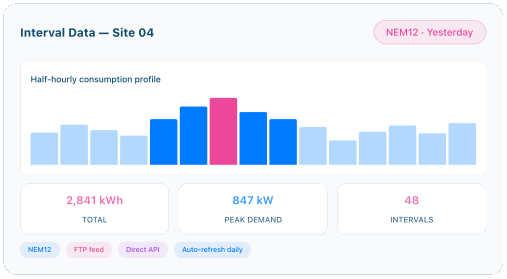
NEM12 interval data from Australia's leading meter data providers.
For sites with interval meters - the majority of commercial and industrial sites in Australia - IQ LAB connects directly to meter data agents to pull NEM12 interval data automatically. 5-minute interval usage and demand profiles updated daily, without depending on CDR retailer connections or manual uploads.
Interval data is more granular and more accurate than billing data alone. It enables meaningful demand analysis, accurate load profiling for procurement tenders and bill validation that compares invoiced amounts against actual metered consumption at the interval level.
IQ LAB integrates with Australia's leading meter data agents - covering the vast majority of commercial and industrial meters across the country.
- 5-minute consumption and demand visibility
- Accurate load profiling for C&I tenders
- Bill validation against actual meter readings
- Demand event identification and analysis
- Trend analysis and anomaly detection
- Automated daily data refresh
NEM12 · FTP · Direct API · Covers the vast majority of C&I meters across Australia.
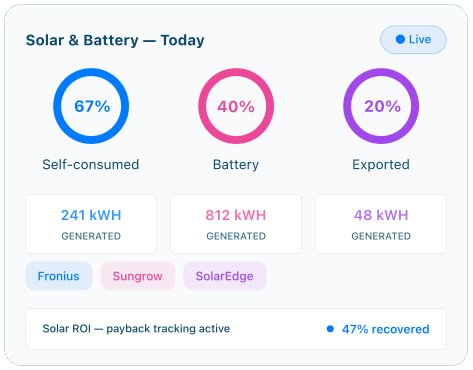
Know what your solar system is actually delivering.
IQ LAB connects directly to solar inverters via secure API - so generation data sits alongside your consumption data in the same platform view. What you're generating, what you're using from the grid, what you're exporting and how your system is performing against expected output. All in one place.
For properties with battery storage, charge, discharge and storage state are tracked in the same view. For businesses that have recently installed solar, IQ LAB tracks payback progress against installation cost and calculates self-consumption ratio over time.
Solar generation feeds directly into Scope 2 reporting. When your system is offsetting grid consumption, your emissions figures reflect it automatically - no manual adjustment.
- Live generation and export data
- Battery charge, discharge and storage performance
- Self-consumption ratio and grid offset
- System performance vs expected output
- Solar ROI and payback tracking
- Automatic Scope 2 emissions update
Secure API via inverter manufacturer data platform. No hardware changes required at site.
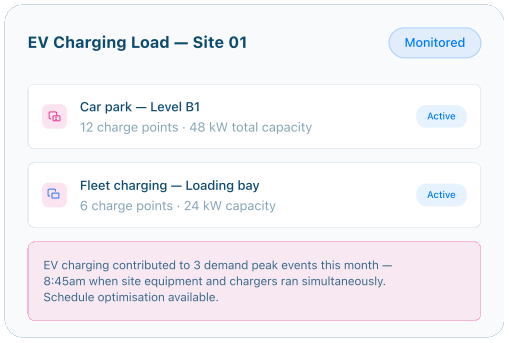
Understand the load impact of EV charging across your sites.
EV charging infrastructure is increasingly present across commercial properties - car parks, logistics facilities, hospitality venues, commercial buildings. The charging load can be significant, particularly during peak trading hours when chargers and site equipment run simultaneously.
IQ LAB monitors EV charging load as part of your site's overall consumption profile - showing how charging events affect your demand peaks, when charging load occurs and what contribution it makes to total site usage. This visibility helps operators time charging events to avoid demand peaks and informs infrastructure planning as EV fleets grow.
- EV charging load as part of total site consumption
- Demand peak impact from charging events
- Charging session timing and load profile
- Infrastructure capacity planning visibility
Connection via Australian-standard charging management protocols. Coverage depends on charging infrastructure at your site.
Track water alongside energy in the same portfolio view.
For operators where water costs rival energy costs - hospitality properties, industrial facilities, large commercial buildings - IQ LAB extends portfolio monitoring to include water consumption alongside electricity and gas. One platform. One view. All utilities.
Water feeds connect through pulse meters, IoT sensors and BMS-integrated water monitoring - depending on the infrastructure available at your sites. Anomaly detection applies to water data in the same way it applies to energy - if overnight water consumption spikes unexpectedly, IQ LAB flags it. Leak detection indicators, equipment faults and unusual consumption patterns surface automatically rather than showing up on the next invoice.
- Water consumption alongside energy in portfolio dashboards
- Anomaly detection - overnight spikes, unexpected usage
- Leak detection indicators
- Cost attribution by site and zone where submetered
- Custom configuration to your site infrastructure
Connection type and data granularity depend on metering infrastructure at each site. IQ LAB's team works with you to establish the right setup.
.svg)
Visibility into your building's largest energy consumers.
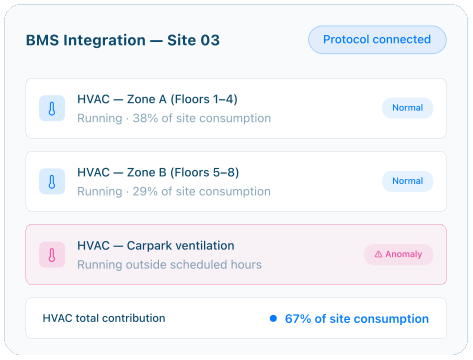
HVAC systems typically represent 30–50% of a commercial building's energy consumption. Building management systems control and monitor that load - but the data they generate rarely finds its way into an energy management platform where it can be analysed alongside consumption data, demand events and billing.
IQ LAB integrates with commercial BMS and HVAC systems through standard building automation protocols - the communication standards used by major commercial BMS platforms operating in Australia. Equipment-level visibility that shows what's driving consumption, when systems are running and how HVAC behaviour correlates with demand peaks.
- HVAC load as part of site consumption profile
- Equipment-level visibility and zone breakdown
- HVAC contribution to demand peak events
- Operating schedule visibility - planned vs actual
- Anomaly detection for out-of-hours equipment operation
Standard building automation protocols · Compatible with major commercial BMS platforms in Australia · No additional hardware required where BMS is installed.
Circuit-level visibility. See where the energy actually goes.
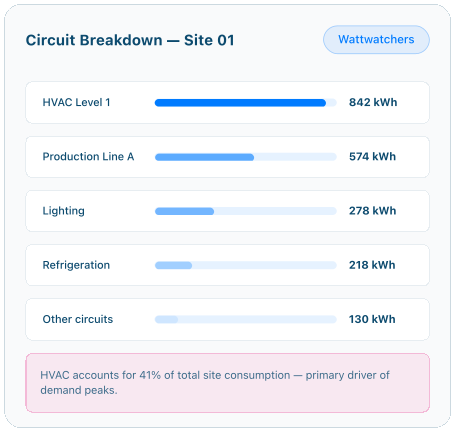
The main meter tells you how much energy a site is using. Submetering tells you where it's going. That distinction matters when you're trying to allocate costs accurately, identify inefficient equipment or understand what's driving demand peaks.
IQ LAB connects to submetering devices - primarily Wattwatchers hardware for Australian deployments - as well as broader IoT sensor networks and protocol-based feeds. Circuit-level data flows directly into the platform alongside main meter and interval data, giving you a layered view of consumption from total site down to individual equipment groups, floors or tenancy zones.
For embedded network operators, submetering integration is the foundation of accurate tenant cost allocation and zone-level sustainability reporting.
- Circuit-level consumption by equipment, zone or floor
- Tenant and cost centre allocation
- Equipment load identification
- Demand peak source identification
- Real-time data where hardware supports it
Direct hardware API for Wattwatchers devices. Protocol-based for Modbus and MQTT. Custom IoT feeds via authenticated API.
Electronic signing built into the procurement workflow.
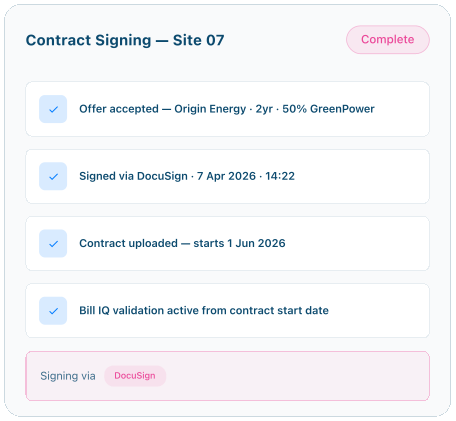
When you accept an offer through IQ LAB's procurement module and are ready to sign, the process continues in the platform - not in an email thread with PDF attachments. Electronic signing is integrated directly through DocuSign, the platform most widely used for commercial contracts in Australia.
Once signed, the contract uploads to IQ LAB automatically. Contract terms, start date, rates and renewal date are captured and fed into the contract management module. Bill IQ validation begins from the contract start date with no manual setup required.
- In-platform signing — no PDF email chains
- Automatic contract upload on signing
- Contract terms and renewal date captured automatically
- Bill IQ validation begins from contract start date
- Full document history per site
How your data moves. Where it lives. Who can see it.
Every integration in IQ LAB follows the same principles: authenticated connections, consent-based data access and Australian data sovereignty.


The integration list grows continuously.
IQ LAB is adding new integrations regularly - retailer CDR connections, hardware manufacturers, BMS platforms and IoT protocols. If you have a specific integration requirement that isn't listed here, talk to us. Our technical team works with clients on custom integration requirements and can advise on connection options, data availability and setup for your specific infrastructure.
Ready to connect your sites?
Talk to the IQ LAB team about your setup - what you have, what you need and how we connect it. Or book a demo to see the integrations working on a live portfolio.